Girt by doubt
The death of a Canadian backpacker is a symptom of a civilisation that no longer believes in itself

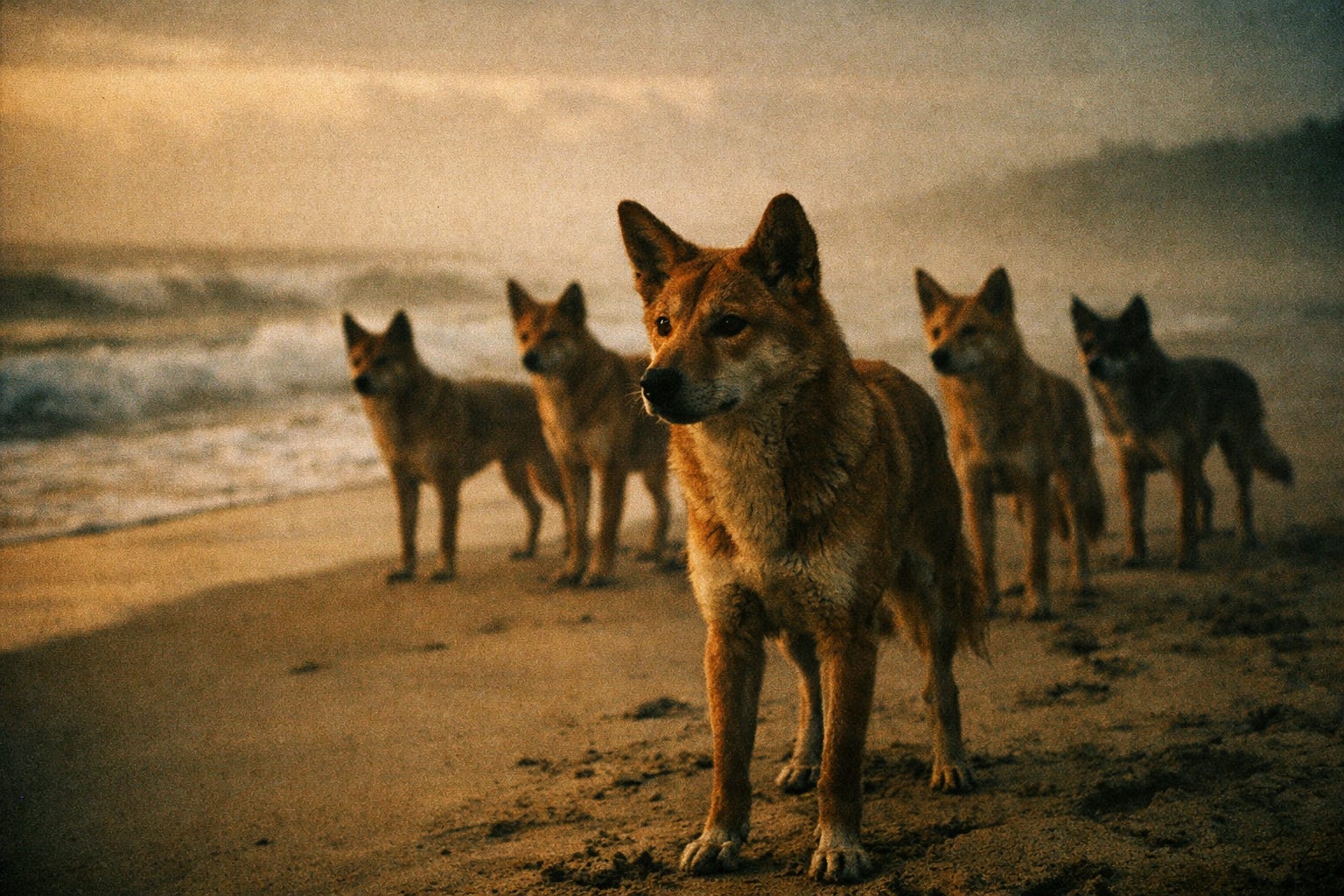
The body of 19-year-old Piper James was found on Fraser Island’s eastern beach last Monday, surrounded by approximately ten dingoes. The Canadian backpacker had gone for an early morning swim near the Maheno Shipwreck; ninety minutes later, two men driving along the beach discovered what police called “a traumatic and horrific scene.” Her body bore markings consistent with interference by dingoes. Whether they killed her or merely scavenged is still under investigation, but Fraser Coast Mayor George Seymour was blunt: given the escalating pattern of attacks, “in some ways it’s inevitable that there will be a fatality.”
Inevitable. That word should disturb us more than it apparently does. A young woman’s death by wild dog on a tourist beach was inevitable; and we decided to accept that inevitability rather than do what every prior generation of Australians would have done without a second thought.
This is not an article about dingoes. It is about us: about a people who have lost the ability to assert their own interests, their own safety, their own right to exist and flourish in the country they have built. The dingo is merely the latest symbol of our civilisational paralysis, our strange new conviction that we must apologise for our own existence and defer to anything - minorities, ideologies, even animals - that can be framed as having a prior or more authentic claim.
Unwanted intruders
Watch how we talk about Fraser Island. The island - named for Eliza Fraser, a shipwreck survivor - was officially renamed to its Butchulla name, K’gari, in 2021. The dingoes are protected as culturally significant. Tourists are instructed to modify their behaviour in elaborate ways: don’t run (it “triggers negative interactions”), carry sticks, stay in groups, camp in fenced areas, and now, never swim alone at dawn.
The message is unmistakable: you are the intruder here. The land and its animals have priority; you must tread carefully, apologetically, aware that you do not truly belong.
This is the posture of a people who have internalised the belief that they have no right to be where they are. And it is killing people.
In 2001, nine-year-old Clinton Gage was killed by dingoes on Fraser Island. In 2023, a pack mauled a 23-year-old jogger so severely that police said the attack was almost fatal: the dogs drove her into the surf before a tourist physically beat them off. Between 1996 and 2001, 279 dingo incidents were recorded, including 39 classified as “major.” The response to this escalating threat? More signage. More education. More instructions to carry sticks and not run.
Any previous generation would have simply shot the dogs. Not out of cruelty, but out of the obvious conviction that human life takes precedence over wild animals on a tourist beach: that we have the right to make places safe for ourselves and our children. That conviction has evaporated.
Dangerous Inaction
Australia has always been home to creatures that can kill you. Saltwater crocodiles patrol the waterways of the tropical north. Great white sharks cruise the coastlines where millions swim each summer. Brown snakes breed within metres of beaches and playgrounds. This is not new.
What is new is our refusal to manage these risks in ways that prioritise human safety and access.
Crocodiles were protected in the 1970s when their numbers had fallen to around 3,000 in the Northern Territory. Now there are 100,000, outnumbering the territory’s human population. The result is that swimming in natural waterways across the entire Top End has become effectively impossible. Children once floated on pandanus branches down the Katherine River; now crocodiles up to four metres long are pulled from those waters. Popular beaches in Far North Queensland close regularly due to sightings. A twelve-year-old girl was killed in July 2024 just weeks after the territory approved a management plan that stopped short of any serious culling.
Shark numbers are exploding along the eastern seaboard, and attacks are increasing. The nets and drum lines that once kept popular beaches safer are now under constant pressure from activists demanding their removal - and governments are listening. Plans to remove nets from Sydney beaches were only paused in 2025 after a fatal attack forced a rethink. The message from conservationists is familiar: learn to coexist, accept the risk, understand that you are entering “their” environment.
Brown snakes, which are responsible for more snakebite deaths than any other Australian species, are allowed to live and breed adjacent to heavily used public spaces within Australian suburbs. No systematic control. No exclusion zones. Just warnings to watch where you step, lest you upset a protected native species.
Dingo as Totem
The protection of Fraser Island’s dingoes is justified on two grounds: that they are “native” and that they hold significance for the Butchulla people. Both claims deserve scrutiny.
Dingoes are not native to Australia in any meaningful sense. According to the Australian Museum, they are “an ancient breed of domestic dog that was introduced to Australia, probably by Asian seafarers, about 4,000 years ago.” The oldest confirmed archaeological date for dingo remains is approximately 3,250 years ago. They are Canis familiaris - the same species as domestic dogs - and they arrived as camp dogs before going feral and contributing to the extinction of the thylacine on mainland Australia.
Four thousand years is a long time, but in terms of Australia’s ecological history, it doesn’t make something native. Aboriginal Australians arrived perhaps 65,000 years ago; the megafauna they encountered (and wiped out) were native. The dingo is protected not because of ecological science but because it has been enrolled in a cultural narrative: a narrative in which Aboriginal connection to land confers a legitimacy that European settlement can never possess. The dingo is a totem of prior ownership, a living rebuke to the colonial presence.
And so we defer. We accept that a wild dog’s cultural significance outweighs a teenage girl’s life. We accept “inevitable” fatalities rather than assert that this is our island too, that we have made it accessible, that tourists come because of infrastructure and services that we built, and that we have every right to make it safe.
In Retreat from Our Own Land
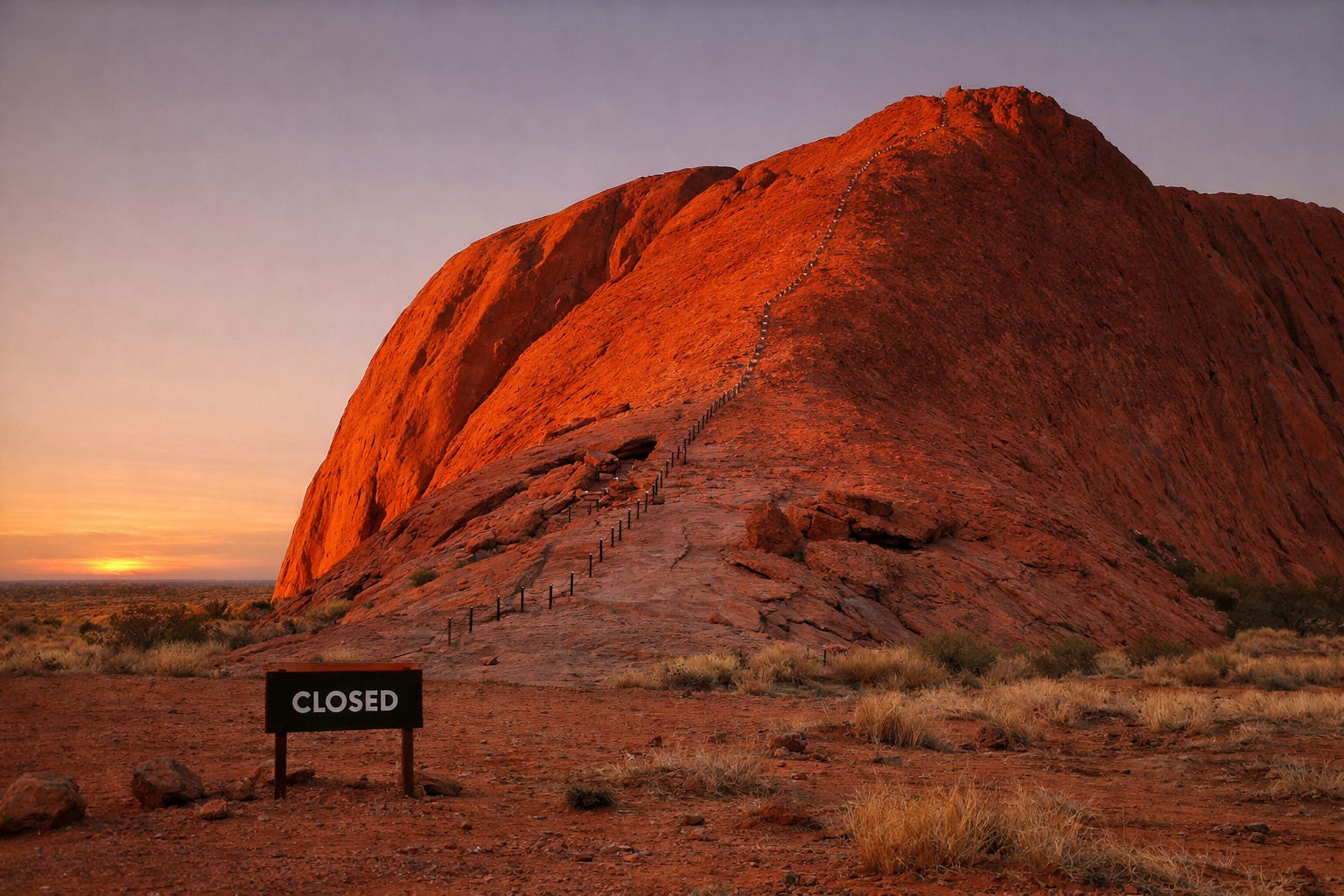
Fraser Island is not an isolated case. Across Australia, we are systematically retreating from natural landmarks and unique experiences because indigenous groups have told us to.
In October 2019, the climb up Ayers Rock (Uluru) was permanently banned. For decades, hundreds of thousands of visitors had made the trek up Australia’s most iconic natural landmark - an experience that connected them viscerally to the continent’s heart. The Anangu people asked for the climb to be closed, and closed it was. Parks Australia now advises that climbing Ayers Rock “is a breach of the Environment Protection and Biodiversity Conservation Act” and that “penalties will be issued to visitors attempting to do so.”
Mount Warning (Wollumbin) in northern New South Wales tells the same story. The summit track, which offered one of Australia’s most spectacular sunrise experiences, was closed during COVID in 2020 and has never reopened. NSW National Parks states that “decisions about the future of the summit track will be made by the NSW National Parks and Wildlife Service in accordance with the wishes of Aboriginal custodians.” Environment Minister James Griffin confirmed that use of the track “conflicted with Aboriginal cultural values.” The Wollumbin Consultative Group has deemed the site “not culturally appropriate or safe” for hikers, or even for images to be taken for tourism purposes.
Ayers Rock and Mount Warning were bucket-list experiences, the kind of encounters with landscape that shape how Australians and visitors understand this continent. They have been closed to us because a small minority claimed a spiritual connection that we are expected to treat as superior to our own desire to experience these places.
The pattern is consistent: wherever indigenous cultural claims conflict with mainstream Australian access to natural landmarks, the mainstream retreats. We apologise. We defer. We put up signs explaining why we can no longer do what Australians have done for generations, and we accept it.
Merciless Exceptions
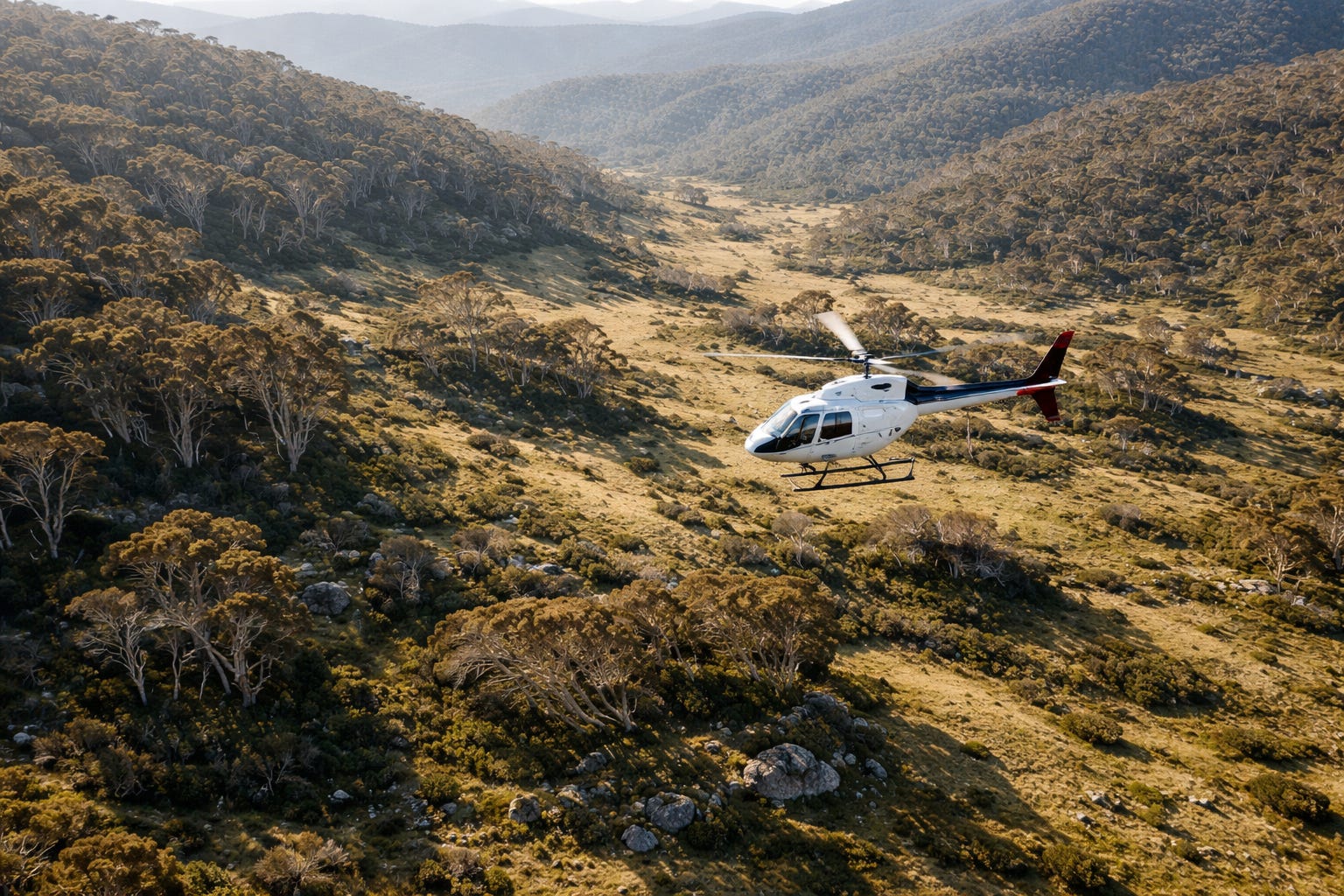
The paralysis around dingoes and sacred sites stands in sharp contrast to how governments behave when the political valence is different.
In Kosciuszko National Park, NSW moved to aerial shooting of feral horses in 2023 - over significant public objection and genuine cultural attachment to brumbies by heritage Australians. The target: 3,000 horses culled by mid-2027. When horse advocates sought a Supreme Court injunction, it was dismissed. In December 2025, the Kosciuszko Wild Horse Heritage Repeal Act stripped away heritage protections entirely.
Where does this resolve come from? Horses threaten bogs and native vegetation -conservation values. Conservation is a cause that doesn’t trigger civilisational guilt. We can act decisively to protect frogs and sphagnum moss because doing so doesn’t require us to assert ourselves against indigenous narratives or question whether we belong here.
We spread poison that kills domestic dogs to protect native wildlife from wild dogs, while protecting wild dogs from humans on tourist beaches.
Poisoned Logic
Consider 1080 aka sodium fluoroacetate a toxin spread across vast swathes of Australia to kill foxes, feral cats, and wild dogs. Western Australia’s Western Shield program baits areas “from Karratha to east of Esperance.” Official advice states that baited areas “must be considered dangerous for pet cats and dogs at all times.” Dogs are banned from national parks explicitly because of baiting programs.
The irony is savage. Dingoes, wild dogs, are protected on Fraser Island, where they stalk children and kill tourists. The same animal is classified as a pest and systematically poisoned across conservation lands elsewhere. We spread poison that kills domestic dogs to protect native wildlife from wild dogs, while protecting wild dogs from humans on tourist beaches.
The policy incoherence is total, but it follows a consistent emotional logic: we can act against animals when doing so serves conservation interests that don’t implicate identity. We cannot act when doing so would require asserting human primacy in a space coded as belonging to someone, or something, else.
The Sickness Inside Us
What kind of people accept “inevitable” fatalities from wild dogs on a tourist beach? What kind of society instructs young women not to swim alone at dawn rather than making the beach safe? What kind of nation closes its most iconic landmarks to its own citizens because a small minority claims spiritual offence?
A society that has lost faith in itself. A society that has absorbed, at some deep level, the proposition that its presence is illegitimate - that the land belongs to someone else, that nature has rights superior to ours, that our desires and even our safety must yield to prior claims we can never match.
This is the sickness of the modern West, and Australia has a particularly acute case. We are taught that this land was “stolen” - not settled, not developed, not transformed from wilderness into a prosperous nation, but stolen, as though the very act of building a civilisation here was a crime. We are taught that Aboriginal Australians have a spiritual connection to country that we can never share, that their 65,000 years confer a legitimacy our 237 years cannot approach.
Absorb this teaching deeply enough and you become incapable of asserting yourself. You cannot say: this beach should be safe for tourists, and if that requires killing dangerous animals, we will kill them. You cannot say: human life matters more than dingo authenticity. You cannot say: Ayers Rock is our landmark too, and we will climb it.
No more apologies
Let me say plainly what our culture has made unsayable: we have the right to be here.
Australians of European descent took this land. Our ancestors built a nation where there had been none: not out of cruelty, but because that is what peoples do. They brought law, technology, medicine, literacy, and British institutions. They transformed a continent. The society they built is worth defending, worth extending, and worth enjoying.
Part of that inheritance is the Australian relationship with the outdoors - the beach, the bush, the vast spaces that define our national character. Access to nature is a birthright. Our beaches, our national parks, our mountains and monoliths should be places where Australians and visitors can walk, swim, climb, and camp.
Let me say plainly what our culture has made unsayable: we have the right to be here.
This does not require exterminating dingoes or wantonly desecrating the landscape. It requires the simple assertion that in places developed for human use - tourist beaches, walking tracks, iconic landmarks - human safety and human access come first. If a mountain has been climbed safely for a century, it stays open. If dingoes in those areas become dangerous, they are culled.
We extend this logic unhesitatingly to horses threatening alpine bogs. We extend it to foxes and cats threatening native wildlife - spreading poison across landscapes and banning pet dogs from parks. The only reason we don’t extend it to dingoes on Fraser Island or access to Ayers Rock is that doing so would require a confidence we no longer possess: the confidence to say that our presence here is legitimate, our way of life is good, and we will not apologise for it.
A Question of Belief
Piper James died on a beach that previous generations of Australians would have made safe without a second thought. She died because we have become a people who cannot bring ourselves to say: our lives matter, our enjoyment matters, our presence here is legitimate.
We are retreating. From beaches where dingoes hunt. From mountains where indigenous groups claim exclusive spiritual access. From the simple conviction that this is our country and we have the right to enjoy it.
The dingoes are not the problem. Our loss of civilisational self-belief is the problem.
The dingoes are not the problem. Our loss of civilisational self-belief is the problem. Until we recover it - until we can say, without apology, that we belong here and intend to flourish - the retreats will continue, the deaths will continue, and the signs telling us where we may not go will multiply.
We need to decide what we believe. A people who believe in themselves do not accept “inevitable” deaths from wild dogs. They do not close their iconic landmarks because a minority objects. They do not apologise for existing.
They act.